
- → The brain cannot delete habits, only brake them: Abandoning a deeply ingrained behavior does not erase it from synaptic memory; the prefrontal cortex must actively overlay an inhibitory stop signal (Bouton, 2004, 2014; Diamond, 2013).
- → Acute stress shifts control to automatic routines: Under severe fatigue or pressure, prefrontal executive resources deplete, handing behavioral steering over to the dorsolateral striatum (Schwabe & Wolf, 2009, 2013).
- → The first sixty days in an unfamiliar environment drain metabolic energy: In unstructured environments, the brain burns substantial glucose and noradrenaline resolving predictive errors (Sara, 2009; Peters et al., 2017).
- → Dissenting against group consensus activates threat circuits: Challenging authority or collective consensus triggers the amygdala similar to physical danger, demanding objective evidence to quell social alarm (Berns et al., 2005; Klucharev et al., 2009).
⚠️ Informational Notice: The insights provided in this guide are intended solely for scientific education and informational purposes. They do not constitute clinical diagnosis, psychiatric consultation, or personalized therapeutic intervention. In cases of chronic attention deficits, burnout, or severe anxiety, always consult a certified healthcare professional.
Summary
- Old habits are never deleted: The mammalian brain cannot scrape away seasoned neural pathways; it can only construct a supervisory “do not execute” brake rule on top of them.
- Fatigue invites old automated patterns back: Sleep deprivation and deadline pressure silence prefrontal executive control, switching behavior into automatic striatal gear.
- The first two months in a new setting heavily deplete metabolic reserves: Lacking predictable templates, the brain expends significantly more glucose resolving prediction errors.
- Challenging group consensus triggers a genuine biological threat response: Voicing disagreement stimulates the amygdala akin to an impending social threat.
Does This Sound Familiar?
Have you ever noticed your hand reflexively clicking an obsolete desktop icon months after your workplace upgraded its software suite? Even when you intellectually know the modern workflow is twice as efficient, by late afternoon you catch yourself retreating to familiar spreadsheets. Meanwhile, a newly hired junior team member adapts to the new platform in forty-eight hours, while your ten years of domain mastery feel like deadweight holding you back.
 Figure 1: Suspended between entrenched habits and a novel workflow, the brain expends continuous metabolic effort to suppress automated routines at every single juncture.
Dianne Na Penn, Product Lead at AI lab Anthropic, highlighted an intriguing operational reality in a recent interview: in fast-pivoting product organizations, junior engineers occasionally outpace senior executives when adapting to paradigm shifts simply because they have “far less unlearning to do.” Why does decades-long experience sometimes transform into a biological liability during transition periods?
The answer lies neither in intellect nor lack of willpower, but rather in the evolutionary rules of neural thermodynamics. Let us explore the molecular and systems neurobiology behind why unlearning poses a far steeper challenge than initial skill acquisition.
1. Why the Brain Cannot Truly Delete an Ingrained Habit
Common productivity rhetoric advises us to “forget the old way and start with a blank slate.” Yet decades of empirical research led by behavioral neuroscientist Mark E. Bouton prove that the mammalian brain possesses no structural delete command. Once a behavioral sequence has been enacted and consolidated thousands of times across corticostriatal loops, its physical synaptic architecture remains intact.
Extinguishing a habit is fundamentally not file deletion; it is stamping a persistent, active red “STOP” seal over an existing file. In cognitive neuroscience, this phenomenon is termed inhibitory learning—constructing a novel repressive rule over a preserved memory trace. The original synaptic groove remains dormant in the deeper basal ganglia.
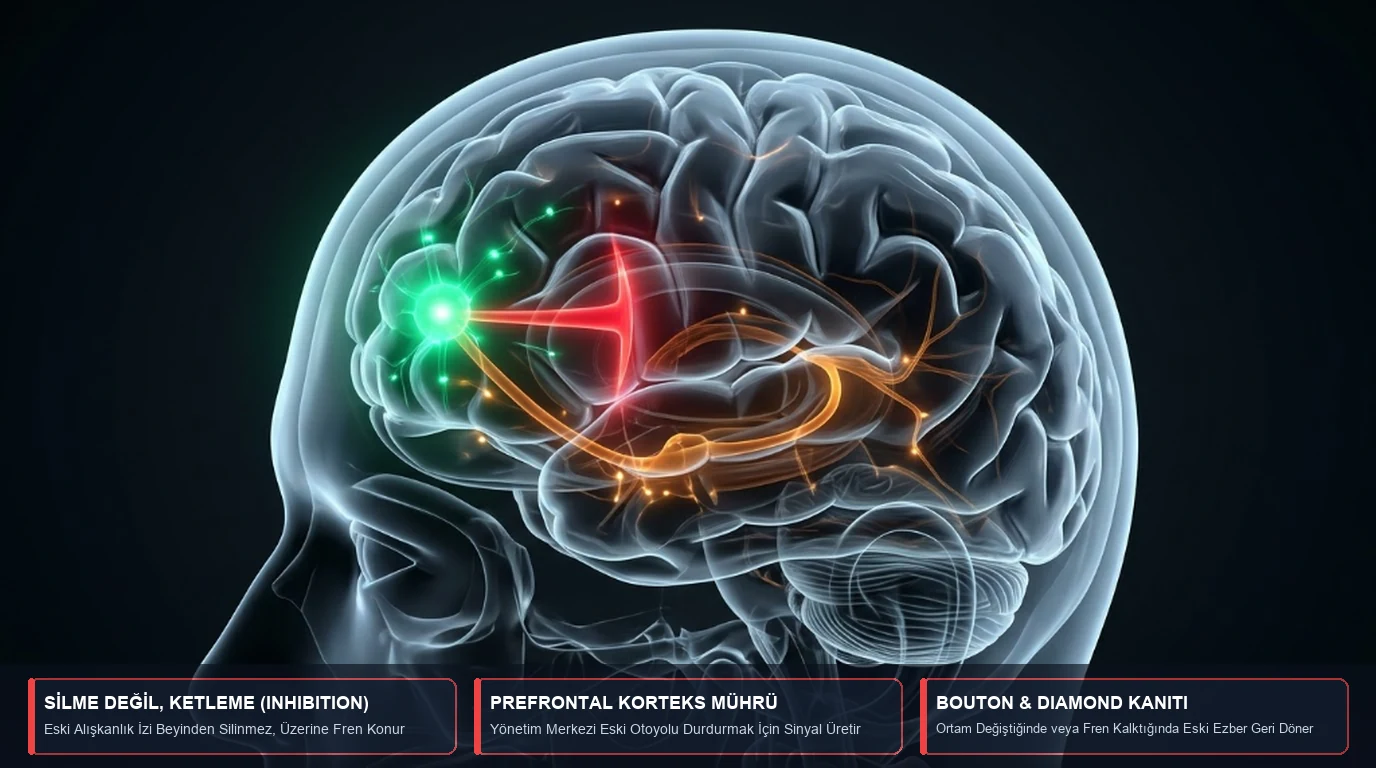 Figure 2: The neural circuitry of an old habit is never physically eradicated; rather, the prefrontal cortex deploys continuous, active inhibitory brake signals to suppress downstream striatal firing.
Research by developmental cognitive neuroscientist Adele Diamond reveals that this inhibitory brake is driven primarily by the prefrontal cortex (PFC)—the brain’s seat of executive function, task-switching, and impulse suppression. In an experienced professional, a decade of procedural repetition resembles an eight-lane paved interstate highway. For a fresh graduate entering the domain, no highway exists; they blaze a brand-new trail across untrampled meadow.
Consequently, seasoned professionals must expend double the cognitive energy during transitions. Executive circuits must construct barricades across the eight-lane highway entrance while simultaneously grading an entirely new path. The profound exhaustion reported by domain experts during structural shifts is directly attributable to this invisible, unrelenting inhibitory workload.
2. Why Stress and Exhaustion Trigger Default Routines
During the morning hours, bolstered by rest and high executive capacity, executing new protocols feels manageable. However, as deadlines loom, cognitive fatigue mounts, or sleep loss accumulates by late afternoon, executive suppression weakens. Involuntarily, your hands default to old habits. Rather than a personal failure of discipline, this reflects a hardwired evolutionary failsafe.
Neuroscientists Lars Schwabe and Oliver T. Wolf engineered classic experiments examining human decision-making under acute physiological stress. By subjecting participants to cold pressor testing—elevating systemic cortisol and autonomic catecholamines—they demonstrated that acute stress selectively impairs flexible, goal-directed behavior, shifting individuals back into rigid stimulus-response habits.
 Figure 3: Under elevated stress hormones and cognitive fatigue, high-energy prefrontal executive control shuts down, delegating behavioral governance to the energy-efficient dorsolateral striatum.
Because the prefrontal cortex is metabolically expensive to run, systemic surges in cortisol and adrenaline initiate an energy conservation protocol. Executive authority is transferred downstream to the dorsolateral striatum—the primitive basal ganglia engine responsible for automated routines and procedural habits. The striatum recognizes no abstract new rules; it merely executes the deepest, most thoroughly reinforced neural trace.
 Figure 4: As neural energetic substrates deplete late in the workday, the brain defaults to the lowest-resistance pathway: automated procedural routines.
Crucially, the inhibitory brake layered over an old habit is context-dependent and fragile. When cognitive resources plunge or contextual stressors spike, the prefrontal brake releases, and the underlying habit re-emerges instantaneously (spontaneous recovery and renewal effects). Much like the impatience loops detailed in our exploration of digital attention residue, a tired brain unhesitatingly prioritizes the least taxing procedural circuit.
3. Why the First Sixty Days in an Unfamiliar Environment Exhaust the Brain
Whether stepping into an unstructured tech venture, pivoting domains, or relocating to an unfamiliar city, newcomers often experience debilitating cognitive exhaustion at the end of each day—even without physical exertion. Seasoned managers at organizations like Anthropic explicitly prepare recruits for this: the initial sixty days are often the most intellectually taxing of their careers. The culprit is the astronomical metabolic cost of environmental uncertainty.
Adapting to an uncharted system is akin to navigating an unlit maze: every single step requires sensory probing and extra neural computation. Groundbreaking work by neurobiologist Susan J. Sara demonstrates that novel or rule-shifting environments instantly activate the locus coeruleus in the brainstem, driving a massive tonic release of noradrenaline (norepinephrine) across the neocortex.
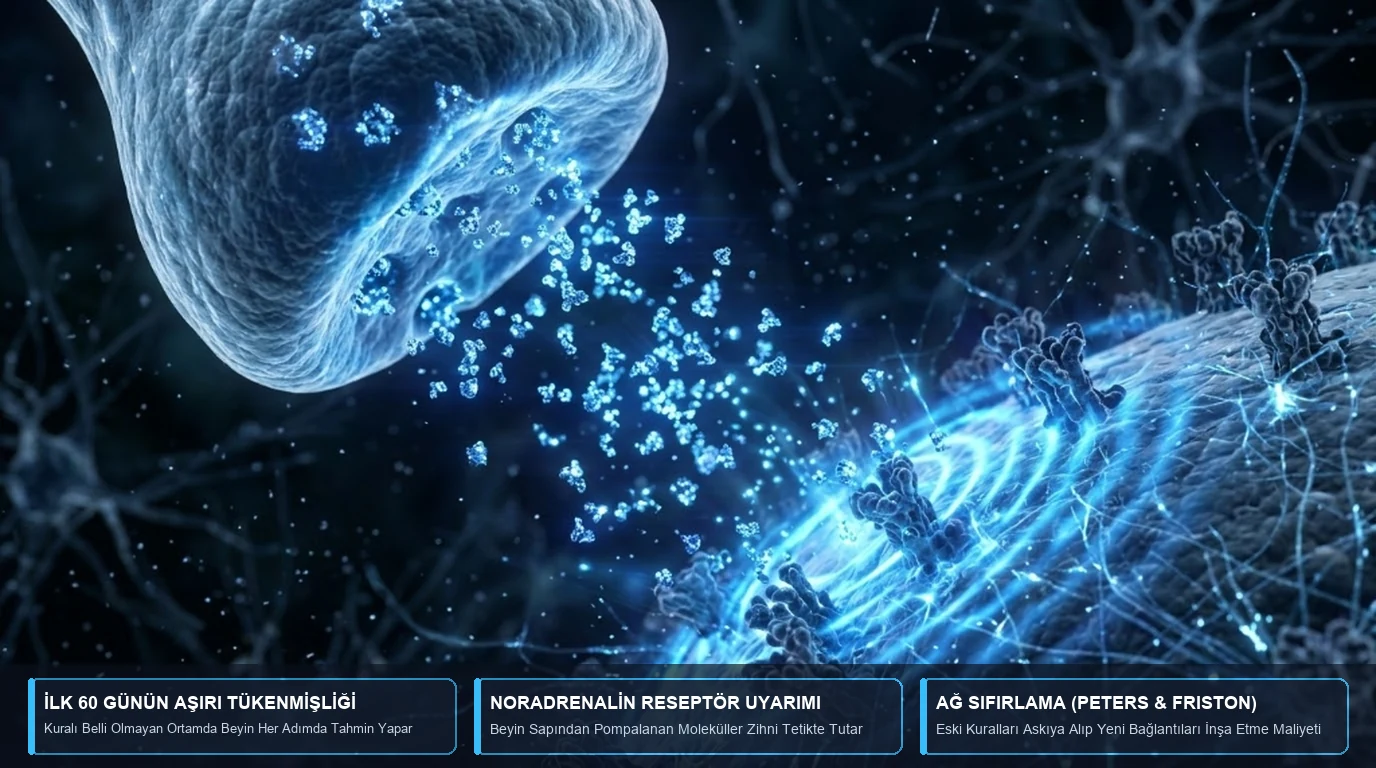 Figure 5: In unmapped environments, the locus coeruleus continuously broadcasts noradrenergic waves, disengaging entrenched network weights to facilitate rapid experiential recalibration.
This chemical influx serves as a global reset signal, commanding neocortical networks: “Past assumptions are invalid here; suspend pre-existing heuristics and map the environmental contingency space.” According to the Selfish Brain and Predictive Processing models advanced by Achim Peters, Bruce S. McEwen, and Karl Friston, the brain is an energetic prediction engine. In a stabilized environment, high predictive accuracy allows the cortex to idle on minimal glucose.
Conversely, entering an uncharted environment unleashes a torrent of high prediction errors. The brain must compute every social nuance, procedural rule, and unspoken hierarchy de novo, monopolizing systemic glucose and oxygen supplies. The crushing end-of-day tension headaches and brain fog experienced during your first months in a new role are not a sign of incompetence—they represent the biological price of real-time cognitive cartography.
4. Why Challenging Group Consensus Registers as an Evolutionary Threat
A profound obstacle when adapting to a new organizational culture is expressing dissent against dominant assumptions. When founders or leadership teams present an initiative that you recognize as fundamentally flawed, voicing disagreement triggers a visceral reaction: a racing pulse, clammy palms, and a sudden impulse to stay silent.
Neuroscientist Gregory S. Berns and colleagues utilized functional MRI (fMRI) to delineate the neural underpinnings of social conformity. Participants were subjected to mental rotation tasks while peers intentionally supplied false answers. Whenever an individual chose to preserve their perceptual accuracy and dissent against unanimous group consensus, fMRI scans captured immediate, robust activation of the amygdala—the brain’s core alarm hub for existential and social threats.
 Figure 6: Dissenting from authority or unanimous group consensus activates the amygdala, signaling a primitive risk of social isolation and ostracization.
To our ancestral biology, separation from the tribe represented imminent mortality; our neural threat architecture interprets social conflict through that identical survival filter. Subsequent research by Vasily Klucharev and colleagues discovered that when an individual’s evaluation deviates from group consensus, the brain generates an immediate neural error-prediction signal akin to committing a physical mistake. The brain actively induces emotional distress to compel conformity and restore tribal safety.
How do elite teams overcome this evolutionary barrier? The solution lies in depersonalizing dissent, framing divergence around empirical evidence and structured inquiry rather than interpersonal conflict. When a contributor enters a discussion armed with objective data, prefrontal executive validation overrides and calms the amygdala’s primitive alarm.
5. Practical Implementation: 4 Rules to Accelerate Neuroplastic Adaptation
Your brain’s tendency to preserve seasoned habits and avoid predictive uncertainty is not a design flaw; it is an optimized, multi-millennium evolutionary survival system. Rather than fighting this architecture, you can leverage its native operating principles through four practical strategies:
💡 4 Neurobiological Principles for Rapid Behavioral Adaptation
1. Target the Trigger Rather Than the Habit: Avoid issuing negative cognitive commands like “I will stop opening the legacy spreadsheet”; executive control cannot efficiently instantiate a negative void. Formulate a definitive implementation intention (If-Then rule): “The moment my hand moves toward the old program icon, I will pause, breathe deeply, and click the new workspace shortcut.”
2. Never Transition Workflows Under Acute Depletion: Do not attempt to master unfamiliar procedures late in the evening or amidst intense production deadlines. When prefrontal glucose and catecholamines dip, the dorsolateral striatum automatically defaults to legacy patterns. Schedule cognitive transitions exclusively during peak morning alertness.
3. Normalize the Initial 60-Day Metabolic Drain: Recognize post-work exhaustion in a new role as expected physiological energy expenditure rather than cognitive inadequacy. Because prediction error resolution draws heavily on systemic energy, protect sleep architecture and avoid unnecessary peripheral decisions during the first two months.
4. Neutralize the Dissent Threat Circuit with Empirical Data: If you must challenge a collective strategy, never enter the discussion unprepared. Formulate objective datasets and exploratory questions (“Looking at our conversion telemetry, what if we test this specific hypothesis?”). Objective framing bypasses the amygdala’s social threat circuitry.
 Figure 7: Placing an explicit, visual trigger-action reminder within immediate line of sight provides external scaffolding for prefrontal inhibitory control.
Scientific Evidentiary Strength
The physiological mechanisms detailed in this clinical review are categorized according to their empirical evidentiary basis below:
| Scientific Mechanism & Finding | Evidentiary Strength |
|---|---|
| Habits are not erased from memory but suppressed via prefrontal inhibitory gating (Bouton, 2004, 2014; Diamond, 2013) | 🟢 Robust Evidence |
| Acute physiological stress induces a shift from goal-directed prefrontal to automated striatal control (Schwabe & Wolf, 2009, 2013) | 🟢 Robust Evidence |
| Dissenting against social or group consensus recruits the amygdala and error-monitoring circuitry (Berns et al., 2005; Klucharev et al., 2009) | 🟢 Robust Evidence |
| Novel, unstructured environments increase locus coeruleus noradrenaline and metabolic energy expenditure (Sara, 2009; Peters et al., 2017) | 🟡 Emerging Evidence |
- 🟢 Robust Evidence: Consistently replicated across multiple independent controlled human neuroimaging paradigms, behavioral animal models, and clinical reviews.
- 🟡 Emerging Evidence: Supported by robust mechanistic frameworks and neurochemical metrics, with ongoing longitudinal research measuring real-time workplace cognitive loads.
- 🔴 Insufficient Evidence: Preliminary correlative observations lacking definitive causal replication.
Frequently Asked Questions
Does it truly take 21 days to break an old habit?
No. The “21-day rule” is a popular myth originating from non-empirical observations. Establishing stable prefrontal inhibitory control over an entrenched behavior requires anywhere from two to eight months of consistent reinforcement, depending on the behavior’s complexity and reward history.
Why does learning feel more demanding as we age?
Age does not eliminate neuroplasticity. However, decades of life experience construct vast, deeply myelinated corticostriatal highways. Adopting an unfamiliar protocol demands continuous, metabolically demanding inhibitory gating to suppress these formidable competing pathways.
How can I stop reverting to bad habits when stressed?
Because acute stress temporally disconnects executive prefrontal circuits, sheer willpower cannot win this battle in the moment. The most effective biological intervention is removing yourself from the triggering environment, cooling facial skin with cold water to stimulate parasympathetic vagal tone, and taking slow, extended diaphragmatic breaths to reduce autonomic arousal before deciding.
Is it normal to have persistent headaches during the first month of a new job?
Yes. When your brain is mapping new organizational dynamics, software workflows, and social hierarchies, its predictive engines run at peak capacity, consuming extraordinary amounts of oxygen and glucose. As workflows become predictable after sixty days, cognitive load normalizes.
Conclusion
Reverting to seasoned habits under pressure or experiencing debilitating exhaustion in an unfamiliar setting is not an indicator of personal deficiency. Your brain is executing its foundational biological mandate: conserving energy, relying on proven survival pathways, and mitigating social isolation. By replacing brute-force willpower with concrete implementation intentions, respecting sleep and cognitive energy boundaries, and grounding workplace dissent in empirical curiosity, you transform biological resistance into sustainable cognitive agility.
Last Updated: October 2026
Verified References & Clinical Citations
- Bouton, M. E. (2004). Context and behavioral processes in extinction. Learning & Memory, 11(5), 485–494. DOI: 10.1101/lm.78804 | PubMed: 15466298
- Bouton, M. E. (2014). Why behavior change is difficult to sustain. Preventive Medicine, 68, 29–36. DOI: 10.1016/j.ypmed.2014.06.010 | PubMed: 24937649
- Diamond, A. (2013). Executive functions. Annual Review of Psychology, 64, 135–168. DOI: 10.1146/annurev-psych-113011-143750 | PubMed: 23020641
- Schwabe, L., & Wolf, O. T. (2009). Stress prompts habit behavior in humans. Journal of Neuroscience, 29(22), 7191–7198. DOI: 10.1523/JNEUROSCI.0979-09.2009 | PubMed: 19494141
- Schwabe, L., & Wolf, O. T. (2013). Stress and multiple memory systems: from ‘thinking’ to ‘doing’. Trends in Cognitive Sciences, 17(2), 60–68. DOI: 10.1016/j.tics.2012.12.001 | PubMed: 23290054
- Dajani, D. R., & Uddin, L. Q. (2015). Demystifying cognitive flexibility: Implications for clinical and developmental neuroscience. Trends in Neurosciences, 38(9), 571–578. DOI: 10.1016/j.tins.2015.07.003 | PubMed: 26343956
- Berns, G. S., Chappelow, J., Zink, C. F., Pagnoni, G., Martin-Skurski, M. E., & Richards, J. (2005). Neurobiological correlates of social conformity and independence during mental rotation. Biological Psychiatry, 58(3), 245–253. DOI: 10.1016/j.biopsych.2005.04.012 | PubMed: 15978553
- Klucharev, V., Hytönen, K., Rijpkema, M., Smidts, A., & Fernández, G. (2009). Reinforcement learning signal predicts social conformity. Neuron, 61(1), 140–151. DOI: 10.1016/j.neuron.2008.11.027 | PubMed: 19146819
- Sara, S. J. (2009). The locus coeruleus and noradrenergic modulation of cognition. Nature Reviews Neuroscience, 10(3), 211–223. DOI: 10.1038/nrn2573 | PubMed: 19190638
- Peters, A., McEwen, B. S., & Friston, K. (2017). Uncertainty and stress: Why it causes diseases and how it is mastered by the brain. Progress in Neurobiology, 156, 164–188. DOI: 10.1016/j.pneurobio.2017.05.004 | PubMed: 28576664
For informational purposes only; consult a physician for medical diagnosis or treatment.