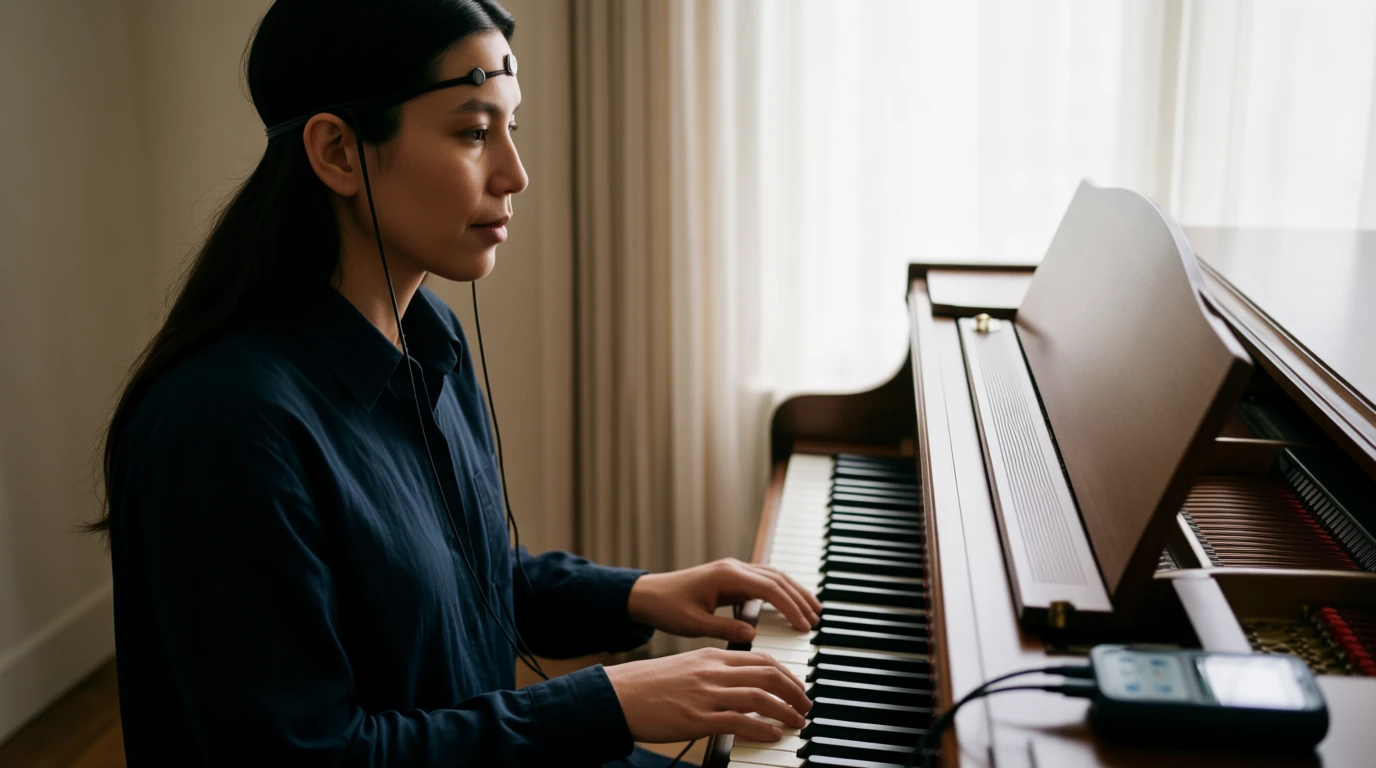
- → Single Sessions Ineffective: A single bout of electrical brain stimulation does not accelerate motor sequence acquisition or enhance 24-hour retention in older adults.
- → Timing Shows No Difference: Delivering stimulation immediately prior to or during physical practice yields no measurable difference in motor performance or cortical hemodynamics.
- → Multi-Day Protocols Offer Promise: Consecutive daily sessions over five days demonstrated measurable reductions in reaction time and error rates lasting up to one week post-training.
- → Inter-Individual Variability: Age, cranial geometry, and genetic polymorphisms dictate intracranial electric field intensity and subsequent physiological responsiveness.
⚖️ Medical Disclaimer: This article is strictly for informational and educational purposes and does not replace medical consultation, clinical diagnosis, or professional neurological treatment.
Quick Summary
- Primary Finding: Delivering weak electrical current across the skull in a single session fails to accelerate motor sequence learning in older adults [1].
- Strength of Evidence: Single-session trials report largely null effects, whereas multi-day repeated protocols offer stronger indications of motor performance facilitation [1, 3].
- Practical Takeaway: Rather than relying on wearable headbands, deliberate and repetitive motor practice remains the single most reliable driver of neural encoding [1].
When learning a tennis serve or tackling a complex piano passage, have you ever wished your motor reflexes would lock in faster? As we grow older, committing novel motor sequences to memory often feels markedly more demanding than in our youth.
In recent years, the biohacking movement has promoted a tantalizing proposition: upgrading human skill acquisition through non-invasive neurotechnology. Chief among these technologies is transcranial direct current stimulation (tDCS)—a method delivering microcurrents (typically 1 to 2 mA) across the scalp to modulate cortical excitability in the primary motor cortex [1]. You can picture it as a battery-powered headband attempting to prime brain circuits for learning.
Can strapping on such a device and pulsing microcurrents through the brain truly accelerate the acquisition of physical skills? Rigorous clinical trials suggest the reality is far more nuanced than marketing claims indicate [1, 5].
Does a Single Stimulation Session Accelerate Motor Skills?
To state the conclusion directly: According to controlled clinical investigations, a single session of tDCS does not meaningfully accelerate the learning of novel motor sequences [1]. In motor neuroscience, this refers to sequential finger or muscular coordination tasks, such as playing musical scales or typing complex keystrokes.
Researchers evaluated 52 older adults undergoing a standardized motor sequence test measuring finger response velocity [1]. One cohort received active transcranial direct current stimulation, while the control cohort received sham stimulation (a brief ramp-up that mimics the tingling sensation without delivering continuous current) [1]. The investigators tested both standard sponge electrodes and high-definition (HD-tDCS) arrays [1]. “High definition” here does not denote screen resolution; rather, it refers to multi-electrode 4x1 ring configurations designed to focus current onto specific cortical targets rather than dispersing across the scalp [1].
At the conclusion of the trial, all participants improved as a function of repeated practice [1]. However, there was no statistically significant divergence in performance between the active stimulation and sham cohorts (p > 0.05) [1]. Focal high-definition montages also failed to outperform conventional setups [1]. Furthermore, 24-hour follow-up assessments revealed zero residual consolidation benefits attributable to the electrical stimulation [1]. In short: the brain progressed through intrinsic motor practice, regardless of external current delivery [1].
Does Stimulation Timing (Online vs. Offline) Alter the Outcome?
Current neuroimaging data reveal that delivering stimulation before or during motor drills makes no substantial difference to learning velocity or cortical blood flow [5].
In a crossover trial examining 20 healthy adults tasked with mastering a sequential finger-tapping exercise with their non-dominant left hands, researchers administered anodal HD-tDCS under two conditions: online (during task execution) and offline (immediately prior to execution) [5]. Cortical hemodynamics and oxygenation levels were simultaneously monitored via functional near-infrared spectroscopy (fNIRS) [5]. Just as exercising a muscle increases local blood flow, active brain regions naturally increase regional oxygenated hemoglobin [5].
The findings demonstrated that stimulation timing did not alter motor proficiency [5]. Moreover, single-session focal stimulation failed to modulate localized hemodynamic activity in the targeted motor cortex [5]. This study reinforces the growing clinical consensus that one-off electrical stimulation does not provide an immediate shortcut to motor expertise [5].
Can Consecutive Multi-Day Protocols Make a Difference?
Here, the clinical trajectory diverges: Repeating stimulation across consecutive daily sessions can meaningfully support motor retention [3].
In a randomized controlled trial investigating 28 highly active older adults, participants performed motor practice over five consecutive days [3]. During training, participants received either active anodal tDCS over the primary motor cortex or sham stimulation [3].
By the end of the five-day protocol, individuals receiving active current demonstrated statistically significant reductions in reaction times and error rates compared to controls [3]. Crucially, these performance gains persisted at 24-hour and one-week follow-up assessments [3]. This indicates that while the brain is resilient to acute single-session stimulation, cumulative daily applications may facilitate synaptic plasticity and long-term potentiation (LTP) mechanisms over time [1, 3].
Does Everyone’s Brain Respond Identically to the Same Current?
Neuroimaging demonstrates that biological responses to transcranial stimulation vary profoundly across individuals and age cohorts [2, 4].
In an extensive neuroimaging study involving 125 adults spanning young and older age brackets, focal stimulation was applied to the motor cortex while brain activity and gamma oscillations were captured using advanced magnetoencephalography and MRI [4]. Older adults exhibited fundamentally different prefrontal-motor functional connectivity and oscillatory responses compared to younger individuals [4].
Furthermore, an overarching systematic analysis underscores why non-invasive brain stimulation frequently yields inconsistent outcomes [2]. Differences in skull thickness, subcutaneous tissue composition, cerebrospinal fluid volume, and sulcal orientation cause identical electrical currents to produce dramatically disparate intracranial field strengths across individuals [2]. Coupled with genetic polymorphisms governing brain-derived neurotrophic factor (BDNF) expression, individual responsiveness is highly variable [2].
Evidence Quality Appraisal
| Finding | Evidence Level |
|---|---|
| Single-session tDCS does not enhance motor sequence learning in older adults | 🟢 Strong |
| Consecutive multi-day stimulation protocols facilitate motor retention | 🟡 Emerging |
| Stimulation response is dictated by individual cranial anatomy and age | 🟢 Strong |
💡 Understanding Evidence Levels:
- 🟢 Strong: Validated through double-blind sham-controlled clinical trials, neuroimaging datasets, and broad consensus.
- 🟡 Emerging: Supported by smaller cohort RCTs or preliminary multi-day protocol demonstrations.
- 🔴 Insufficient: Lacks controlled human verification, conflicting evidence, or confined to animal models.
Practical Daily Takeaways
Consumer marketplaces feature numerous portable headsets claiming to enhance cognitive speed, reflex agility, and athletic precision. Yet rigorous neuroscience establishes that single bouts with these gadgets offer no measurable performance boost [1, 5].
In clinical research environments, investigators typically employ 1 milliampere (mA) for 20 minutes under strict impedance monitoring [1, 4, 5]. These parameters represent experimental boundary conditions, not consumer dosing recommendations.
If you are picking up a musical instrument or mastering a technical athletic movement, relying on natural learning physiology remains the safest, most effective path. Structured deliberate practice, spaced repetition, and deep sleep are the true biological drivers of long-term motor consolidation [1].
Safety and Clinical Considerations
Applying electrical currents to the human skull is not an innocuous hobbyist endeavor. In clinical trials, participants are screened and monitored in specialized laboratory settings with medical-grade current limiters [1, 3, 4, 5].
Research studies exclusively enrolled specific cohorts of healthy young volunteers or high-functioning older adults [1, 3, 4, 5]. Safety data are completely lacking for individuals with epilepsy, metal implants, neurological disorders, diabetes, pregnancy, or those taking neuroactive medications (such as SSRIs or antiepileptics).
Furthermore, the long-term safety profile of chronic home stimulation, pediatric exposure, and standard dosing algorithms remain uncharacterized [1, 2, 3, 4, 5]. Because anatomical variation can cause unpredictable current densities and potential skin burns or cortical dysregulation, unmonitored self-experimentation carries significant risk [2]. Always consult a neurologist or clinical neurophysiologist before considering any neuromodulation technology.
Evidence Summary
- Kerstens et al. (2026) [1]: Double-blind, sham-controlled parallel and crossover trial; 52 older adults; single-session conventional and high-definition anodal tDCS yielded no significant effect on motor sequence learning or 24-hour consolidation (p > 0.05).
- Timashkov et al. (2026) [2]: Systematic literature review; healthy individuals and clinical populations; demonstrated that outcome inconsistency stems from intracranial electric field distribution, cranial anatomy, and genetic polymorphisms.
- Talimkhani et al. (2026) [3]: Randomized controlled trial; 28 high-activity older adults; 5 consecutive daily sessions of anodal tDCS over primary motor cortex produced durable improvements in reaction time and accuracy retained up to one week post-intervention.
- Arif et al. (2026) [4]: Neuroimaging investigation; 125 young and older adults; anodal HD-tDCS modulated prefrontal-motor connectivity and gamma oscillations in a polarity- and age-dependent manner.
- Jin et al. (2025) [5]: Single-blind crossover study; 20 healthy adults; timing of anodal HD-tDCS (online vs. offline) to non-dominant primary motor cortex failed to alter hemodynamics or accelerate motor sequence acquisition.
Verified References & Scientific Sources
- Kerstens S, Broeder S, Gilat M, Nackaerts E, Vandendoorent B, Nieuwboer A, Orban de Xivry JJ. No effect of anodal high-definition transcranial direct current stimulation during motor sequence learning in older people. GeroScience. 2026. PMID: 42667528 | DOI:
10.1007/s11357-026-02457-8 - Timashkov A, Andreev S, Safonova A, Zangieva S, Kadieva D, Zinchenko O. The inconsistent effects of tDCS in rehabilitation and cognitive enhancement: sources of variability and paths to personalization. Frontiers in Human Neuroscience. 2026;20:1817726. PMID: 42370069 | DOI:
10.3389/fnhum.2026.1817726 - Talimkhani A, Abedi R, Daryabor A, Mohammadzadeh Z, Naimi SS, Rahnama L. The Impact of Multiple Sessions of Anodal Transcranial Direct Current Stimulation on Implicit Motor Learning in High-Activity Older Adults: A Randomized Control Trial. Journal of Aging and Physical Activity. 2026. PMID: 41130445 | DOI:
10.1123/japa.2024-0281 - Arif Y, Huang PJ, Springer SD, Okelberry HJ, John JA, Petro NM, Garrison GM, Kress KA, McDonald KM, Picci G, Wilson TW. High-definition tDCS of the motor cortex affects prefrontal and primary motor activity differently in young and older adults. GeroScience. 2026. PMID: 41449268 | DOI:
10.1007/s11357-025-02012-x - Jin M, Xu X, Zhang Z, Xia W, Lou X, Bai Z. Timing of high-definition transcranial direct current stimulation to the nondominant primary motor cortex fails to modulate cortical hemodynamic activity and improve motor sequence learning. Journal of NeuroEngineering and Rehabilitation. 2025;22:12. PMID: 39891195 | DOI:
10.1186/s12984-025-01546-7
For informational purposes only; consult a physician for medical diagnosis or treatment.